


Page 98 - CityofSouthlakeFY27Budget
P. 98
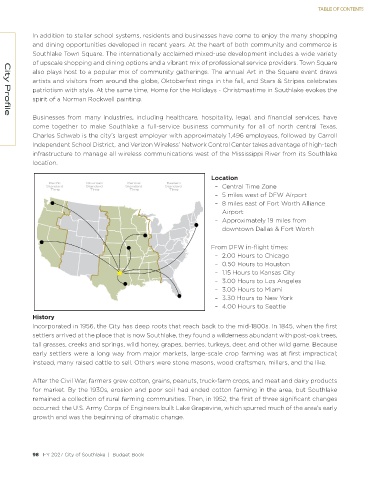
TABLE OF CONTENTS


            In addition to stellar school systems, residents and businesses have come to enjoy the many shopping
            and dining opportunities developed in recent years. At the heart of both community and commerce is
            Southlake Town Square. The internationally acclaimed mixed-use development includes a wide variety
            of upscale shopping and dining options and a vibrant mix of professional service providers. Town Square
            also plays host to a popular mix of community gatherings. The annual Art in the Square event draws
            artists and visitors from around the globe, Oktoberfest rings in the fall, and Stars & Stripes celebrates
            patriotism with style. At the same time, Home for the Holidays - Christmastime in Southlake evokes the
            spirit of a Norman Rockwell painting.

            Businesses from many industries, including healthcare, hospitality, legal, and financial services, have
   City Profile
            come together to make Southlake a full-service business community  for all of north central Texas.
            Charles Schwab is the city’s largest employer with approximately 1,496 employees, followed by Carroll
            Independent School District,  and Verizon Wireless’ Network Control Center takes advantage of high-tech
            infrastructure to manage all wireless communications west of the Mississippi River from its Southlake
            location.

                                                                       Location
                                                                           – Central Time Zone
                                                                           – 5 miles west of DFW Airport
                                                                           – 8 miles east of Fort Worth Alliance
                                                                          Airport
                                                                           – Approximately 19 miles from
                                                                          downtown Dallas & Fort Worth


                                                                       From DFW in-flight times:
                                                                           – 2.00 Hours to Chicago
                                                                           – 0.50 Hours to Houston
                                                                           – 1.15 Hours to Kansas City
                                                                           – 3.00 Hours to Los Angeles
                                                                           – 3.00 Hours to Miami
                                                                           – 3.30 Hours to New York
                                                                           – 4.00 Hours to Seattle
            History
            Incorporated in 1956, the City has deep roots that reach back to the mid-1800s. In 1845, when the first
            settlers arrived at the place that is now Southlake, they found a wilderness abundant with post-oak trees,
            tall grasses, creeks and springs, wild honey, grapes, berries, turkeys, deer, and other wild game. Because
            early settlers were a long way from major markets, large-scale crop farming was at first impractical;
            instead, many raised cattle to sell. Others were stone masons, wood craftsmen, millers, and the like.


            After the Civil War, farmers grew cotton, grains, peanuts, truck-farm crops, and meat and dairy products
            for market. By the 1930s, erosion and poor soil had ended cotton farming in the area, but Southlake
            remained a collection of rural farming communities. Then, in 1952, the first of three significant changes
            occurred: the U.S. Army Corps of Engineers built Lake Grapevine, which spurred much of the area’s early
            growth and was the beginning of dramatic change.


            98   FY 2027 City of Southlake  |  Budget Book                                                                                                                                            FY 2027 City of Southlake  |  Budget Book   99

