


Page 301 - CityofSouthlakeFY27Budget
P. 301
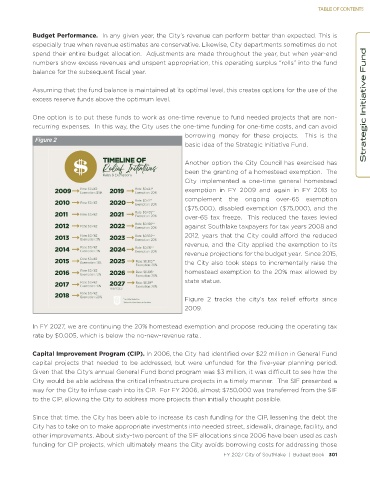
TABLE OF CONTENTS


            Budget Performance.  In any given year, the City’s revenue can perform better than expected. This is
            especially true when revenue estimates are conservative. Likewise, City departments sometimes do not
            spend their entire budget allocation.  Adjustments are made throughout the year, but when year-end
            numbers show excess revenues and unspent appropriation, this operating surplus “rolls” into the fund
            balance for the subsequent fiscal year.


            Assuming that the fund balance is maintained at its optimal level, this creates options for the use of the
            excess reserve funds above the optimum level.                                                                 Strategic Initiative Fund

            One option is to put these funds to work as one-time revenue to fund needed projects that are non-
            recurring expenses.  In this way, the City uses the one-time funding for one-time costs, and can avoid
                                                              borrowing  money for these  projects.   This  is the
             Figure 2
                                                              basic idea of the Strategic Initiative Fund.


                                                              Another option the City Council has exercised has
                                                              been the granting of a homestead exemption.  The
                                                              City implemented a one-time general homestead
                                                              exemption in FY 2009 and again in FY 2013 to
                                                              complement the ongoing over-65 exemption
                                                              ($75,000), disabled exemption ($75,000), and the
                                                              over-65 tax freeze.  This reduced the taxes levied
                                                              against Southlake taxpayers for tax years 2008 and
                                                              2012, years that the City could afford the reduced
                                                              revenue, and the City applied the exemption to its
                                                              revenue projections for the budget year.  Since 2015,
                                                              the City also took steps to incrementally raise the
                                                              homestead exemption to the 20% max allowed by
                                                              state statue.


                                                              Figure 2 tracks the city’s tax relief efforts since
                                                              2009.

            In FY 2027, we are continuing the 20% homestead exemption and propose reducing the operating tax
            rate by $0.005, which is below the no-new-revenue rate..


            Capital Improvement Program (CIP). In 2006, the City had identified over $22 million in General Fund
            capital projects that needed to be addressed, but were unfunded for the five-year planning period.
            Given that the City’s annual General Fund bond program was $3 million, it was difficult to see how the
            City would be able address the critical infrastructure projects in a timely manner.  The SIF presented a
            way for the City to infuse cash into its CIP.  For FY 2006, almost $750,000 was transferred from the SIF
            to the CIP, allowing the City to address more projects than initially thought possible.

            Since that time, the City has been able to increase its cash funding for the CIP, lessening the debt the
            City has to take on to make appropriate investments into needed street, sidewalk, drainage, facility, and
            other improvements. About sixty-two percent of the SIF allocations since 2006 have been used as cash
            funding for CIP projects, which ultimately means the City avoids borrowing costs for addressing those
                                                                           FY 2027 City of Southlake  |  Budget Book   301

