


Page 173 - CityofSouthlakeFY27Budget
P. 173
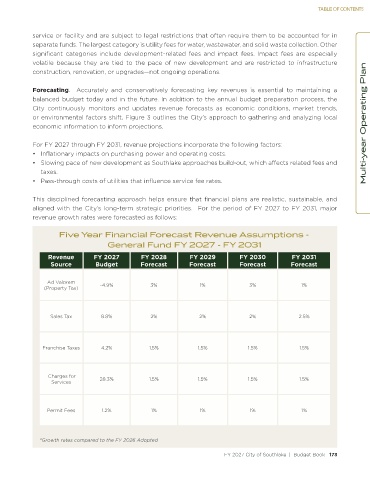
TABLE OF CONTENTS


            service or facility and are subject to legal restrictions that often require them to be accounted for in
            separate funds. The largest category is utility fees for water, wastewater, and solid waste collection. Other
            significant categories include development-related fees and impact fees. Impact fees are especially
            volatile because they are tied to the pace of new development and are restricted to infrastructure
            construction, renovation, or upgrades—not ongoing operations.


            Forecasting.  Accurately and conservatively forecasting key revenues is essential to maintaining a
            balanced budget today and in the future. In addition to the annual budget preparation process, the
            City continuously monitors and updates revenue forecasts as economic conditions, market trends,
            or environmental factors shift. Figure 3 outlines the City’s approach to gathering and analyzing local
            economic information to inform projections.                                                                   Multi-year Operating Plan


            For FY 2027 through FY 2031, revenue projections incorporate the following factors:
            •  Inflationary impacts on purchasing power and operating costs.
            •  Slowing pace of new development as Southlake approaches build-out, which affects related fees and
               taxes.
            •  Pass-through costs of utilities that influence service fee rates.


            This disciplined forecasting approach helps ensure that financial plans are realistic, sustainable, and
            aligned with the City’s long-term strategic priorities.  For the period of FY 2027 to FY 2031, major
            revenue growth rates were forecasted as follows:


                     Five Year Financial Forecast Revenue Assumptions -
                                     General Fund FY 2027 - FY 2031
                 Revenue        FY 2027         FY 2028         FY 2029         FY 2030           FY 2031
                  Source         Budget         Forecast        Forecast        Forecast         Forecast


                 Ad Valorem
                (Property Tax)    -4.9%            3%              1%              3%                1%


                  Sales Tax       8.8%             2%              2%               2%              2.5%


               Franchise Taxes    4.2%            1.5%            1.5%             1.5%             1.5%


                 Charges for      28.3%           1.5%            1.5%             1.5%             1.5%
                  Services


                 Permit Fees       1.2%            1%              1%               1%               1%


              *Growth rates compared to the FY 2026 Adopted

                                                                           FY 2027 City of Southlake  |  Budget Book   173

