


Page 334 - CityofSouthlakeFY26AdoptedBudget
P. 334
Sales Tax Districts


                                       Southlake Sales Tax Districts


            As with all other special revenue funds, sales tax districts revenues are designated for specific purposes.
   Special Revenue Funds
            State law regulates both the types of sales tax districts cities may utilize and the use of their funds, and
            the final approval of all sales tax districts is up to the voters. In Southlake, the total sales tax rate is 8.25%.
            Of that, the City receives a $0.02 of sales tax for every dollar spent in our city limits (the remainder goes
            to the State).

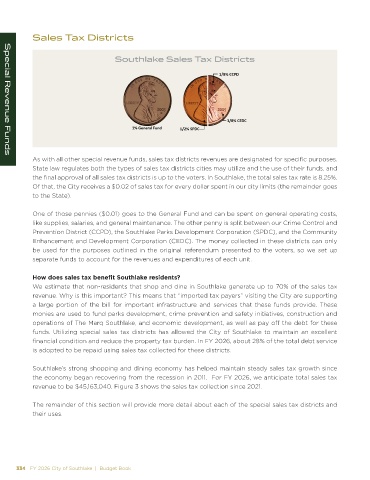
            One of those pennies ($0.01) goes to the General Fund and can be spent on general operating costs,
            like supplies, salaries, and general maintenance. The other penny is split between our Crime Control and
            Prevention District (CCPD), the Southlake Parks Development Corporation (SPDC), and the Community
            Enhancement and Development Corporation (CEDC). The money collected in these districts can only
            be used for the purposes outlined in the original referendum presented to the voters, so we set up
            separate funds to account for the revenues and expenditures of each unit.

            How does sales tax benefit Southlake residents?
            We estimate that non-residents that shop and dine in Southlake generate up to 70% of the sales tax
            revenue. Why is this important? This means that “imported tax payers” visiting the City are supporting
            a large portion of the bill for important infrastructure and services that these  funds provide. These
            monies are used to fund parks development, crime prevention and safety initiatives, construction and
            operations of The Marq Southlake, and economic development, as well as pay off the debt for these
            funds. Utilizing special sales tax districts has allowed the City of Southlake to maintain an excellent
            financial condition and reduce the property tax burden. In FY 2026, about 28% of the total debt service
            is adopted to be repaid using sales tax collected for these districts.


            Southlake’s strong shopping and dining economy has helped maintain steady sales tax growth since
            the economy began recovering from the recession in 2011.  For FY 2026, we anticipate total sales tax
            revenue to be $45,163,040. Figure 3 shows the sales tax collection since 2021.


            The remainder of this section will provide more detail about each of the special sales tax districts and
            their uses.


      334   FY 2026 City of Southlake  |  Budget Book

