


Page 61 - Microsoft Word - FY26 Budget Book Intro
P. 61
FY 2025-26 ADOPTED BUDGET


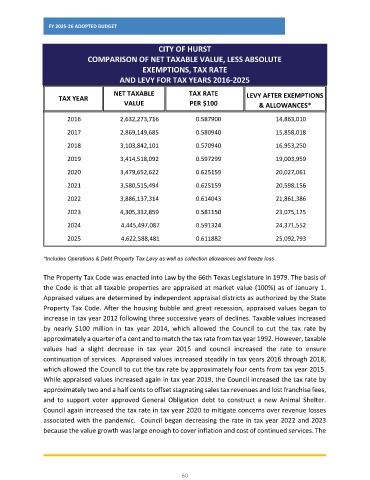
                                                     CITY OF HURST
                              COMPARISON OF NET TAXABLE VALUE, LESS ABSOLUTE
                                                EXEMPTIONS, TAX RATE
                                         AND LEVY FOR TAX YEARS 2016-2025

                                       NET TAXABLE              TAX RATE           LEVY AFTER EXEMPTIONS
                    TAX YEAR
                                          VALUE                  PER $100              & ALLOWANCES*


                       2016              2,632,273,716            0.587900                   14,863,010
                       2017              2,869,149,685            0.580940                   15,858,018

                       2018              3,103,842,101            0.570940                   16,953,250

                       2019              3,414,518,092            0.597299                   19,003,959
                       2020              3,479,652,622            0.625159                   20,027,061

                       2021              3,580,515,494            0.625159                   20,598,156

                       2022              3,886,137,314            0.614043                   21,861,386

                       2023              4,305,332,859            0.581150                   23,075,125

                       2024               4,445,497,087           0.591324                  24,371,552
                       2025               4,622,588,481           0.611882                  25,092,793


               *Includes Operations & Debt Property Tax Levy as well as collection allowances and freeze loss

               The Property Tax Code was enacted into Law by the 66th Texas Legislature in 1979. The basis of
               the Code is that all taxable properties are appraised at market value (100%) as of January 1.
               Appraised values are determined by independent appraisal districts as authorized by the State

               Property Tax Code. After the housing bubble and great recession, appraised values began to
               increase in tax year 2012 following three successive years of declines. Taxable values increased
               by  nearly  $100  million  in  tax  year  2014,  which  allowed  the  Council  to  cut  the  tax  rate  by
               approximately a quarter of a cent and to match the tax rate from tax year 1992. However, taxable
               values  had  a  slight  decrease  in  tax  year  2015  and  council  increased  the  rate  to  ensure
               continuation of services.  Appraised values increased steadily in tax years 2016 through 2018,
               which allowed the Council to cut the tax rate by approximately four cents from tax year 2015.
               While appraised values increased again in tax year 2019, the Council increased the tax rate by
               approximately two and a half cents to offset stagnating sales tax revenues and lost franchise fees,

               and  to  support  voter  approved  General  Obligation  debt  to  construct  a  new  Animal  Shelter.
               Council again increased the tax rate in tax year 2020 to mitigate concerns over revenue losses
               associated with the pandemic.  Council began decreasing the rate in tax year 2022 and 2023
               because the value growth was large enough to cover inflation and cost of continued services. The


                                                             60

