


Page 70 - CityofGrapevineFY26AdoptedBudget
P. 70
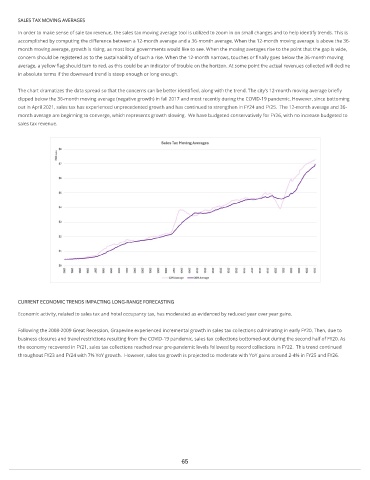
SALES TAX MOVING AVERAGES
       In order to make sense of sale tax revenue, the sales tax moving average tool is utilized to zoom in on small changes and to help identify trends. This is
       accomplished by computing the difference between a 12-month average and a 36-month average. When the 12-month moving average is above the 36-
       month moving average, growth is rising, as most local governments would like to see. When the moving averages rise to the point that the gap is wide,
       concern should be registered as to the sustainability of such a rise. When the 12-month narrows, touches or finally goes below the 36-month moving
       average, a yellow flag should turn to red, as this could be an indicator of trouble on the horizon. At some point the actual revenues collected will decline
       in absolute terms if the downward trend is steep enough or long enough.

       The chart dramatizes the data spread so that the concerns can be better identified, along with the trend. The city’s 12-month moving average briefly
       dipped below the 36-month moving average (negative growth) in fall 2017 and most recently during the COVID-19 pandemic. However, since bottoming
       out in April 2021, sales tax has experienced unprecedented growth and has continued to strengthen in FY24 and FY25.  The 12-month average and 36-
       month average are beginning to converge, which represents growth slowing.  We have budgeted conservatively for FY26, with no increase budgeted to
       sales tax revenue.


       CURRENT ECONOMIC TRENDS IMPACTING LONG-RANGE FORECASTING
       Economic activity, related to sales tax and hotel occupancy tax, has moderated as evidenced by reduced year over year gains.


       Following the 2008-2009 Great Recession, Grapevine experienced incremental growth in sales tax collections culminating in early FY20. Then, due to
       business closures and travel restrictions resulting from the COVID-19 pandemic, sales tax collections bottomed-out during the second half of FY20. As
       the economy recovered in FY21, sales tax collections reached near pre-pandemic levels followed by record collections in FY22.  This trend continued
       throughout FY23 and FY24 with 7% YoY growth.  However, sales tax growth is projected to moderate with YoY gains around 2-4% in FY25 and FY26.


                                                             65

